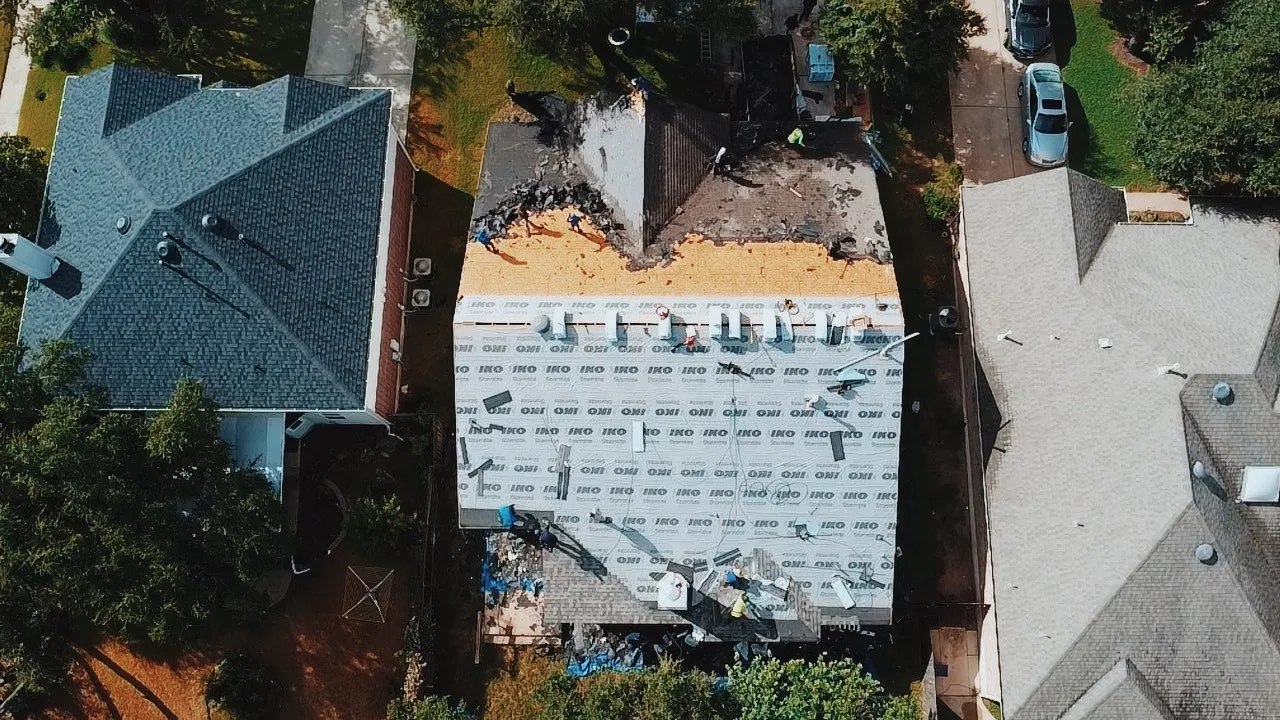
Roof underlayment is the sheet of felt or synthetic material fastened to the roof deck before the shingles go on. Roof underlayment is the second layer of water protection on a shingle roof, which is why one missing shingle on a Central Texas home does not usually mean a wet ceiling the same afternoon. Underlayment is also the layer homeowners tend to expect too much from, so it helps to know what it can and cannot do.
What is roof underlayment?
Roof underlayment is a water-shedding sheet that covers the wood roof deck underneath the shingles. The Asphalt Roofing Manufacturers Association, the shingle makers’ trade group, says in its underlayment bulletin that asphalt shingles should not be installed directly on a wood deck, and that the deck should be covered by underlayment first.
ARMA lists what that layer is for. Underlayment gives the deck a secondary layer of protection from wind-driven rain. Underlayment keeps the deck dry between tear-off and shingling. Underlayment also keeps resins in the wood sheathing away from the shingles, and it is a required part of a fire-classified roof assembly.
What types of roof underlayment are there?
Three kinds of underlayment go under asphalt shingles: asphalt-saturated felt, synthetic sheets and self-adhering membranes. ARMA’s bulletin describes each one this way.
| Type | What it is | Where it is used |
|---|---|---|
| Asphalt-saturated felt | Water-resistant felt sold as No. 15 and the heavier No. 30. It absorbs some moisture. | The traditional choice across the whole deck. |
| Synthetic | A polymer sheet, lighter than felt, that covers more roof per roll. | Across the whole deck on the roofs we install. |
| Self-adhering membrane | A sticky modified-asphalt sheet that seals around the shanks of roofing nails. | Valleys, ridges and hips, and around vents, skylights and chimneys. |
ARMA adds one caution about the third kind. A self-adhering membrane acts as a vapor retarder, so attic ventilation matters more when it covers an entire roof deck.
What does Texas building code require under shingles?
Texas code requires underlayment under every asphalt shingle roof, and it requires more of it on low slopes. The 2012 International Residential Code, which Texas law adopts as the municipal residential code, sets the rules in Chapter 9.
- Slope. Asphalt shingles are allowed only on roofs with a slope of 2:12 or steeper.
- Standard slopes. A roof at 4:12 or steeper gets one layer of underlayment, run parallel to the eave and lapped 2 inches like shingles so water runs over each seam.
- Low slopes. A roof from 2:12 up to 4:12 gets two layers, because water drains more slowly off a shallow pitch.
- Ice barrier. Where the local climate table records a history of ice backing up at the eaves, the code calls for an ice barrier reaching at least 24 inches inside the exterior wall line.
Cities can amend the code, so the permit office in Liberty Hill, Georgetown or Leander has the final word on a given address.
Will the roof leak if a shingle blows off?
A roof with a missing shingle can stay dry for a while if the underlayment beneath it is intact, but underlayment is not built to be the roof. GAF, a shingle manufacturer, states in a technical bulletin that synthetic underlayment is not waterproof, that it does not seal around nails, staples or laps, and that it should not be used as a temporary roof to protect property.
Underlayment can also leave with the shingles. FEMA’s coastal construction guide treats underlayment as a secondary water barrier and notes that a single tacked layer of felt has limited resistance to blowing off. Once the wood itself is showing, water gets in quickly. The Insurance Institute for Business & Home Safety reports from its testing that every inch of rain on an exposed roof deck can put the equivalent of nine bathtubs of water into a house, and that sealing the seams of the deck can cut that water entry by up to 95 percent.
That gap between a missing shingle and a bare deck is where an emergency roof tarp earns its place. The tarp covers the exposed area until a permanent repair goes on.
How long can roof underlayment stay exposed?
Exposed underlayment should be covered as soon as the weather allows. GAF’s bulletin says the UV exposure rating on synthetic underlayment is typically 90 or 180 days depending on the product, and that the rating only describes how long the sheet resists breaking down in sunlight. The rating says nothing about how well the sheet holds out water or wind.
ARMA gives the same advice from the other direction: shingles should go on as soon after the underlayment as possible. If water has already reached the ceiling, the U.S. Environmental Protection Agency’s mold guide says to dry water-damaged areas within 24 to 48 hours to prevent mold growth.
How can you tell if the underlayment is exposed?
Exposed underlayment shows from the ground as a flat patch that does not match the shingles around it, usually black felt or a printed gray or blue synthetic sheet. Shingle pieces in the yard after a windy night are the other sign. Look from the driveway or with binoculars, and leave the roof itself to someone with the right equipment.
The National Roofing Contractors Association recommends a roof inspection twice yearly, in spring and fall, and after any severe storm. An inspection is how torn or badly lapped underlayment gets found before it becomes a stain.
What we do with underlayment on a repair or a new roof
On a roof repair, we lift the shingles around the damage and check the underlayment before anything new goes down. A torn or wrinkled section gets replaced and lapped over the course below it, so the repair sheds water the way the rest of the roof does.
On a roof replacement, we strip the old shingles and underlayment to bare decking, replace any deteriorated wood, and cover the full deck in synthetic underlayment with leak barriers at the vulnerable spots before the shingles go on. If you can see a bare patch on your roof in Liberty Hill, Georgetown, Leander or Cedar Park, call us and we will come look at what is under it.