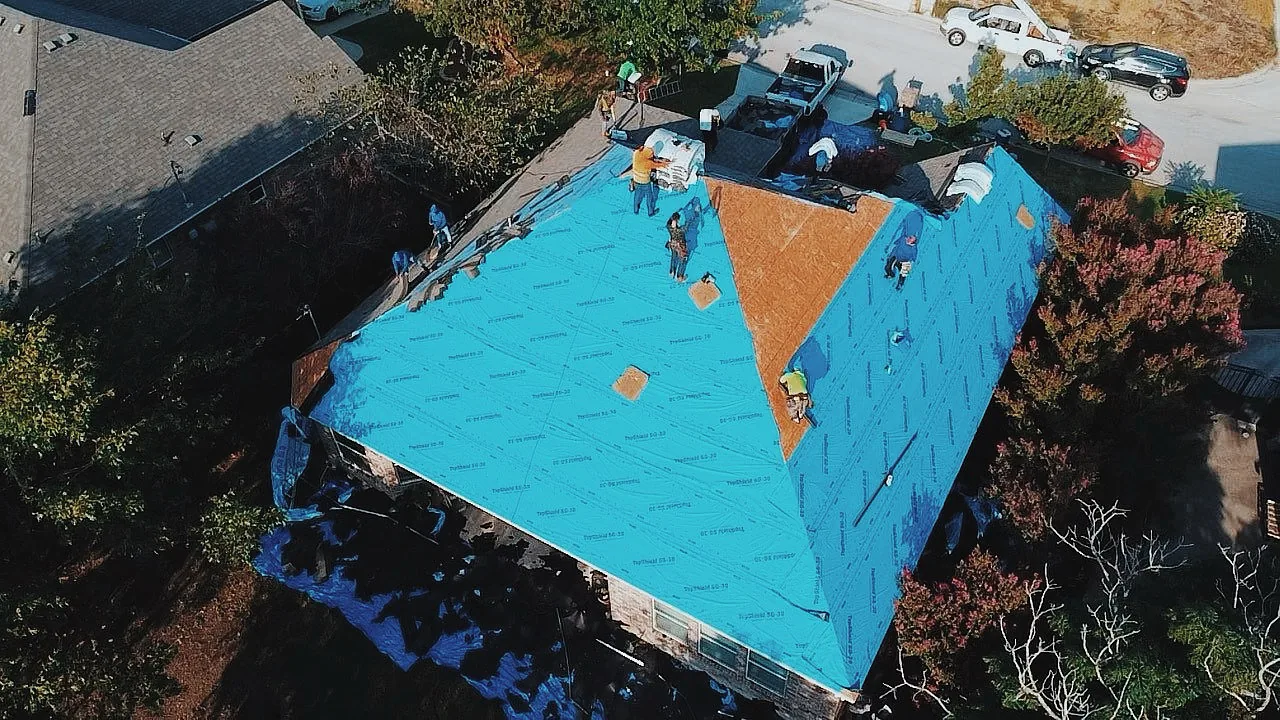
An emergency roof tarp is a temporary cover fastened over a damaged section of roof to keep rain out until the real repair can be made. Done properly it holds for weeks, not months: the US Army Corps of Engineers, which installs tarps across disaster areas for FEMA, builds its own to protect a roof for a minimum of 30 days. A tarp buys time. It is not a repair, and the sooner the roof underneath it is fixed, the less it costs you in wet decking and ceilings.
We are based in Liberty Hill and we tarp and repair roofs across Georgetown, Leander, Cedar Park, Round Rock and Austin. This is what a tarp is for, how one should go on, and what you can safely do from inside the house while you wait.
What is an emergency roof tarp for?
An emergency roof tarp exists to stop water getting into the house through a hole, a lifted section or a run of missing shingles after a storm. The Corps of Engineers describes its Operation Blue Roof sheeting as cover for damaged roofs until arrangements can be made for permanent repairs, and that is the right way to think about any tarp.
Operation Blue Roof itself only runs after a declared disaster: the Corps of Engineers starts it when FEMA assigns the mission at the affected state's request. After an ordinary Central Texas hail or wind storm, there is no federal program on your street, and a tarp comes from a roofer.
How should a roof tarp be fastened?
A roof tarp that is going to survive a few weeks of Texas weather is fastened down with wood strips, not tied on with rope. The Corps of Engineers’ Jacksonville District describes its crews using fiber-reinforced polyethylene sheeting, galvanized steel nails and 1x2 furring strips, with nails every 24 inches along each strip and the strips placed 6 feet apart.
The difference shows up in wind. FEMA contrasts its self-help tarps, loose-fitting waterproof sheets tied to a structure with grommets, with blue roof sheeting held down by wood strips and nails. The Corps of Engineers calls the contractor-installed sheeting the stronger material. A tarp held by a few ropes and bricks tends to become a sail.
| Question | What the Corps of Engineers and FEMA say |
|---|---|
| What is it made of? | Fiber-reinforced polyethylene sheeting, galvanized steel nails and 1x2 furring strips |
| How is it held down? | Nails every 24 inches along each furring strip, strips 6 feet apart |
| How long is it meant to last? | A minimum of 30 days from installation; FEMA says designed to last 30 days |
| Is it guaranteed? | No. The Corps of Engineers states the temporary roof is not warrantied |
How long does an emergency roof tarp last?
An emergency roof tarp is built to last about a month. FEMA states plainly that blue roofs are designed to last for 30 days, and the Corps of Engineers writes its own as protecting a roof for a minimum of 30 days, with no warranty.
The tarp also leaves something behind. The Corps of Engineers notes that removing a temporary roof is the homeowner's job and that it will leave leaks once the nails come out. That is one more reason the permanent repair and the tarp removal should be planned as a single job by the same crew.
Which roofs can’t be tarped the usual way?
Some roofs are too damaged, or the wrong material, for a standard nailed tarp. Operation Blue Roof only covers a house with no more than 50 percent of the roof framing damaged, because the framing has to hold the sheeting. The program does not cover slate, asbestos or clay tile roofs, and considers metal roofs case by case.
On an asphalt shingle roof, a tarp fastened down with wood strips is the standard answer. If the framing itself is broken, the job stops being a tarp and becomes structural work, and we will say so on the first visit.
What should you do inside while you wait?
Everything useful before the tarp goes on can be done from inside the house. The Texas Department of Insurance tells homeowners after a storm to make temporary repairs to prevent more damage, remove standing water, and cover broken windows and holes to keep rain out. Put buckets under drips, move furniture and electronics out of the way, and take photographs of the ceilings and walls before you clean anything up.
Keep water away from electricity. The American Red Cross advises turning off power at the main breaker if you see sparks or frayed wires or smell hot insulation, and never standing in water to reach the panel. A ceiling light with water coming through it is a breaker problem first and a roof problem second.
Then dry what you can. The EPA says water-damaged areas and items should be dried within 24 to 48 hours to prevent mold growth. Fans, a dehumidifier and pulling up a soaked rug all count, and the Red Cross recommends saving the receipts for whatever temporary repairs you make.
Why you shouldn’t put the tarp on yourself
Putting a tarp on your own roof after a storm is one of the more dangerous jobs a homeowner can take on. OSHA’s roof tarping fact sheet tells workers never to install a tarp while it is windy or raining, and warns that a tarped roof is very slippery, especially when wet. Those are the conditions right after a storm.
The falls are not rare. CDC’s National Institute for Occupational Safety and Health reports that more than 500,000 people are treated and about 300 people die each year in the US from ladder-related injuries. OSHA counts 389 fatal falls to a lower level among 1,034 construction deaths in 2024, and NIOSH lists roofing contractors among the trades with the highest number of fall deaths in 2022. Those are trained workers with harnesses. Stay on the ground.
How we handle a tarp call
When you call us about a leak after a storm, we look at where the water is getting in, cover the damaged section with sheeting fastened down with wood strips, and photograph the damage before and after so you have a record. Then we come back for the permanent fix, which is usually a roof repair on the damaged section and occasionally, when the deck or the layers rule a repair out, a replacement.
If water is coming in now, contact us or call (512) 619-2976 and tell us where the leak is showing up inside. We will tell you honestly when we can get there.