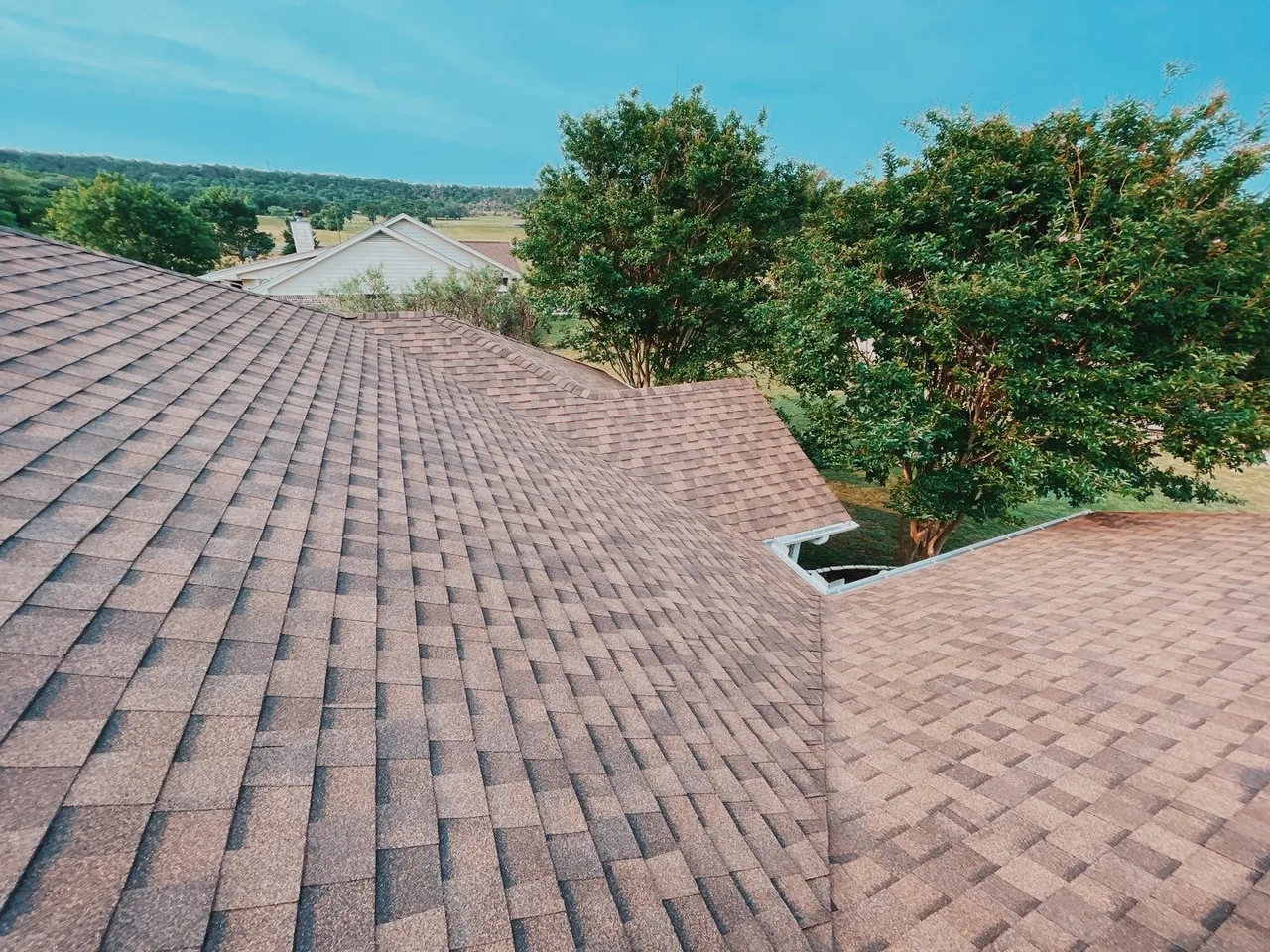
A Class 4 shingle is one that passed the toughest level of the UL 2218 impact test: a 2.00-inch steel ball dropped on the same spot twice without cracking the back of the shingle. It is the highest of four classes, and it is a real improvement over an unrated shingle. It is also a lab test on a brand-new product, and the Insurance Institute for Business & Home Safety has spent years showing that two Class 4 shingles can perform very differently in actual hail.
We replace roofs in Liberty Hill, Georgetown, Leander, Cedar Park, Round Rock and Austin, and the question we hear after every spring storm is whether the next roof should be built to take hail. This is what the rating means, what it leaves out, and how to choose.
What does a Class 4 impact rating mean?
A Class 4 impact rating means the shingle passed UL 2218 at its highest level. UL Solutions describes the standard as producing four ratings, Class 1 through Class 4, by dropping steel balls that replicate the impact energy of natural hailstones. IBHS gives the ball sizes: 1.25 inches for Class 1, 1.50 inches for Class 2, 1.75 inches for Class 3 and 2.00 inches for Class 4.
The pass rule is narrow. According to IBHS’s Roof 101, a product passes if no crack is visible on the back of the shingle after two impacts in the same location. A second test, FM Approvals’ Standard 4473, fires freezer ice balls instead of steel, propelled to match the energy of falling hail of the same size.
| UL 2218 class | Steel ball diameter |
|---|---|
| Class 1 | 1.25 inches |
| Class 2 | 1.50 inches |
| Class 3 | 1.75 inches |
| Class 4 | 2.00 inches |
What does the Class 4 test leave out?
The Class 4 test does not measure the damage a homeowner actually sees. UL Solutions states that UL 2218 ratings do not account for denting or granule loss, which are the marks a homeowner or an adjuster notices on a roof after a storm. The test only asks whether the back of the shingle cracked.
The test also only sees a new shingle. IBHS notes that these standards evaluate new products and do not account for weathering, temperature or aging, and FM Approvals’ own standard warns that long exposure to the elements can significantly lower a roof covering’s hail resistance. IBHS has measured that directly: at its short-term roof aging farm, natural weathering measurably reduced hail impact performance, and repeated hail sped up the decline.
Are all Class 4 shingles the same?
No. IBHS says plainly that not all impact-resistant shingles are designed equally. In testing it published in 2014, covering 22 products from 5 manufacturers, none of the products, impact-rated or basic, passed more than Class 2 impacts without at least one double-impact location failing.
How the shingle is built made the difference. IBHS describes two ways to make a shingle impact resistant: a reinforcing scrim on the back, or a polymer-modified asphalt. In that 2014 testing, Class 4 impacts produced passing results for about 55 percent of polymer-modified impact-rated shingles, against about 35 percent of traditional impact-rated ones.
How does IBHS rate impact-resistant shingles now?
IBHS has rated impact-resistant shingles with laboratory-made hailstones since 2019, judging each one on the damage real hail causes: dents, tears and granule loss. Its 2025 ratings covered a record 24 products, about 95 percent of the impact-resistant shingles sold each year. Most earned Good, and none earned Excellent.
The ratings below Good matter most. Dr. Anne Cope of IBHS put it directly: if a product rates Marginal or Poor, IBHS does not recommend using it in areas that experience hail. For the 2023 update, nine products received a Good or Excellent overall rating. The FORTIFIED program, also run by IBHS, now requires shingles rated Excellent or Good on those ratings for its hail supplement.
Why it matters in Central Texas
Hail in this part of Texas regularly reaches the size these tests are built around. NOAA’s National Severe Storms Laboratory treats hail of 1 inch, quarter size, or larger as severe, and puts hail between 1 and 1.75 inches falling at roughly 25 to 40 mph. Our post on what a hail damage inspection finds has the Williamson County storm record.
What about a metal roof?
Metal handles hail differently from shingles rather than simply better. IBHS and RICOWI guidance on low-slope metal roofs says small hail dents, where the paint has not cracked or flaked, typically do not affect weatherability or structural performance. The Texas Department of Insurance makes the same point for homeowners: metal can dent or scratch from hail in ways that may not affect how it performs but do affect how it looks.
Metal roofing is not one of the services on our site, so this post does not go further into it. If you are weighing it, ask your insurance agent how your policy treats a dented metal roof before you decide, and read TDI’s guidance on metal roofs first.
How we would choose a shingle for your roof
If your roof is due for replacement and hail is the worry, the label on the bundle is the start, not the answer. We would look for a product carrying a Class 4 rating that also rates Good or better on IBHS’s current list, and talk through how it is built.
We will tell you plainly what an impact-rated shingle can and cannot promise. No shingle is hail-proof, the test is run on a new product, and a roof still needs looking at after a big storm. If you want to talk it through for your house, get in touch.