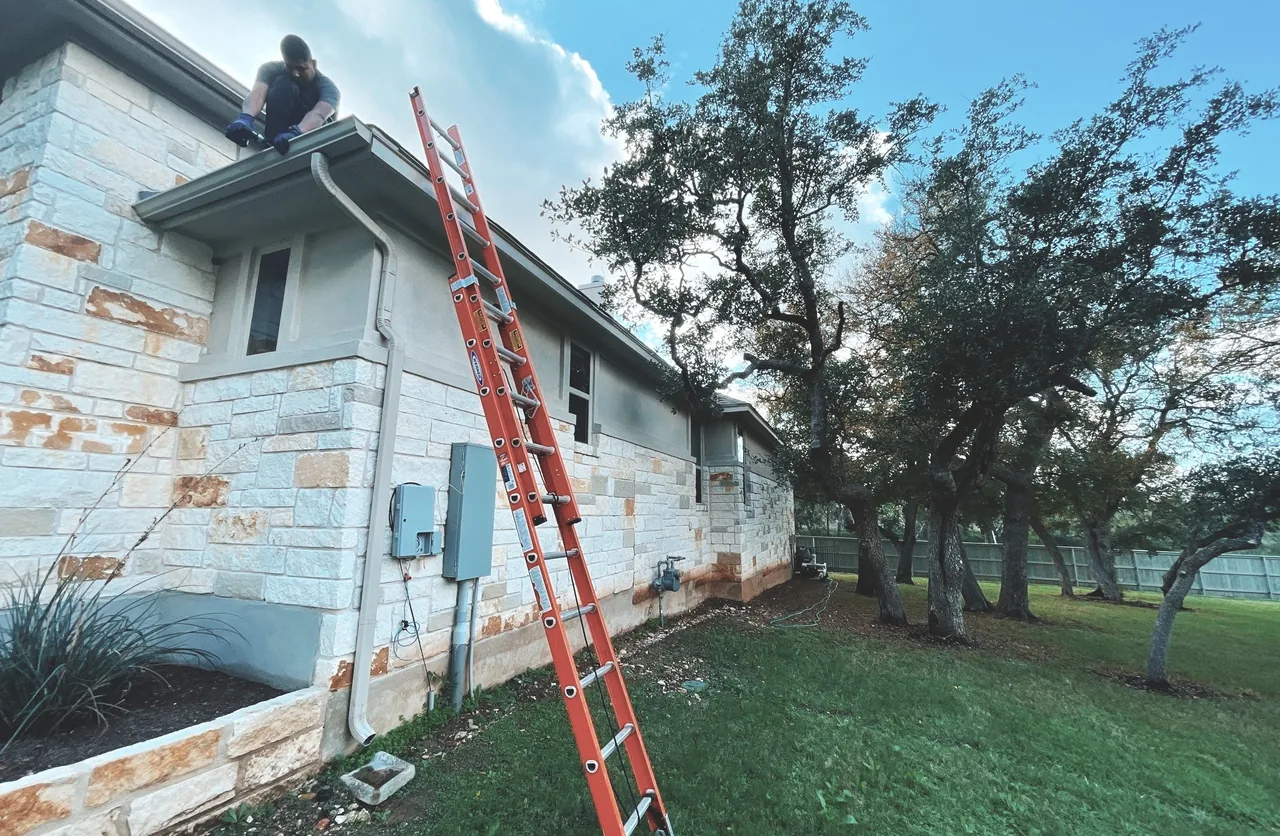
A hail damage roof inspection is a close look for five specific things: bruises in the shingle you can feel with a thumb, granules knocked away in a random scatter, dents in metal flashing and vents, spatter and dings on the things around the house, and the condition of the layers underneath. It is not a look from the driveway. Most of what hail does to an asphalt roof cannot be seen from the ground, and some of what looks like hail damage from the ground turns out to be something else.
We are based in Liberty Hill and we inspect roofs across Georgetown, Cedar Park, Leander, Round Rock and Austin. This is what we are looking at up there, and how we tell the difference.
What does hail damage look like on a shingle?
Hail damage on an asphalt shingle is usually a bruise rather than a hole. The Insurance Institute for Business and Home Safety, which fires laboratory ice at shingles for a living, describes a genuine hail impact as something that can usually be felt on the shingle rather than only seen. A thumb run across the spot finds a soft dimple where the mat underneath has been crushed.
The second marker is pattern. IBHS notes that real hail strikes land in a random pattern across a roof. Damage that lines up in rows, or gathers along one edge only, is usually telling a different story.
The third is granule loss with the asphalt showing through. Granules are ceramic-coated crushed rock, and the Asphalt Roofing Manufacturers Association describes their job as shielding the asphalt underneath from ultraviolet light. Where a stone has knocked a patch of them away, the black asphalt is bare.
What gets mistaken for hail damage?
Several ordinary roof conditions look like hail damage and are not. IBHS lists manufacturer defects, general granule loss along the edges of shingles, mechanical marks left during installation, blisters, and plain weathering as the usual look-alikes.
| What you see from the ground | What it often turns out to be |
|---|---|
| Granules missing in a line along a shingle edge | General granule loss from normal weathering, which IBHS lists as a common hail look-alike |
| Round raised spots in the shingle surface | Blistering, a heat and manufacturing condition rather than an impact |
| Scuffs and gouges in a walking path across the slope | Mechanical marks left during installation or later work on the roof |
| Damage that repeats in a regular pattern | A manufacturer defect. Real hail lands randomly |
| Dark speckles on flashing, vents or the air conditioning unit | Spatter, which is oxidation knocked loose. Evidence that hail fell, but not damage in itself |
Spatter deserves its own note. IBHS is direct that spatter is not damage: it is oxidation or dirt knocked off a metal surface by a stone. It is still worth photographing, because it is evidence that hail actually landed on your property.
How big does hail have to be to damage a roof?
One inch across, the size of a quarter, is where the National Weather Service begins calling hail severe, according to NOAA's National Severe Storms Laboratory. That is a storm-reporting threshold rather than a damage threshold for shingles, but it is the number everything else gets measured against.
Speed is the part most people underestimate. NOAA NSSL puts hailstones under an inch at roughly 9 to 25 mph, hail between 1 and 1.75 inches at roughly 25 to 40 mph, and hail between 2 and 4 inches at roughly 44 to 72 mph.
Energy climbs faster than diameter does. In its impact test protocol, IBHS fires ice spheres of 1.5 inches and 2.0 inches at shingles, carrying 6.9 joules and 24 joules respectively. Half an inch more diameter arrives with more than three times the energy.
For what actually falls in this part of the state, the nearest government analysis is a 2020 National Weather Service study by Stephen Harrison of the San Angelo office, covering west central Texas rather than our area exactly. Of 3,488 severe hail reports between 1955 and 2020, 41.3 percent measured between 1 and 1.75 inches, and 58.7 percent were 1.75 inches or larger.
Why a bruise matters when the roof is not leaking
A bruised shingle is a roof with its outer defense thinned, not a roof with a hole in it. ARMA describes the shingle as a small system: a fiberglass mat for the backbone, an asphalt coating that sheds water and holds the granules, and the granules shielding that asphalt from the sun. Underlayment sits below all of it as a secondary water-resistant layer.
Knock the granules off a patch and the asphalt there takes ultraviolet light it was never built to take. ARMA is plain that exposed asphalt deteriorates. IBHS states the consequence simply: hail can shorten the life of a roof covering.
That is why an inspection after a storm is worth doing while nothing is dripping. The damage is real before it is visible indoors.
What we write down during an inspection
An inspection is only as good as the record it leaves. We work the roof slope by slope, photograph what we find with something in the frame for scale, and note which slope and which elevation each photograph came from.
We check the things around the roof as well, because IBHS treats them as corroboration: dents in metal flashing, dings in the fins of the air conditioning condenser, spatter on painted metal, and marks on gutters and downspouts. A stone big enough to dent a gutter is worth a close look at the shingles above it.
We note the date of the storm, the age and condition of the roof where we can establish it, anything we find that is not hail, and the state of the flashing, vents and penetrations. If the roof is sound, we write that down too. A clean inspection is a useful document to own.
Where our part stops and your insurer's begins
We inspect, we document, and if you decide to repair or replace, we do the work. Your insurance company sends its own adjuster, and that adjuster is the person who decides your claim. We are glad to be on site when they come and show them what we found and where.
We do not tell homeowners what a claim is worth or what an insurer will approve. Texas keeps roofing and claims adjusting as two separate jobs, and we keep to ours. If you want the sequence laid out before you start, our insurance process page covers what usually happens and in what order.
When to have a roof looked at
Spring is when hail arrives here and autumn is when people find out what it did. In that same National Weather Service analysis of west central Texas, 94 percent of very large hail reports occurred between March and June, with May the most active month.
By October, a roof that took a beating in May has had a summer of Texas sun on whatever those stones exposed. That is the argument for looking before winter rather than after it. Nothing about this is an emergency and there is no deadline we are inventing. It is simply easier to look at a roof in October than in February.
If your roof has been through a hailstorm and nobody has been up there since, we will come and look and leave you the photographs and the written record either way. Where an inspection turns up damage worth fixing, that is roof repair, and we will tell you plainly if the answer is that nothing needs doing.