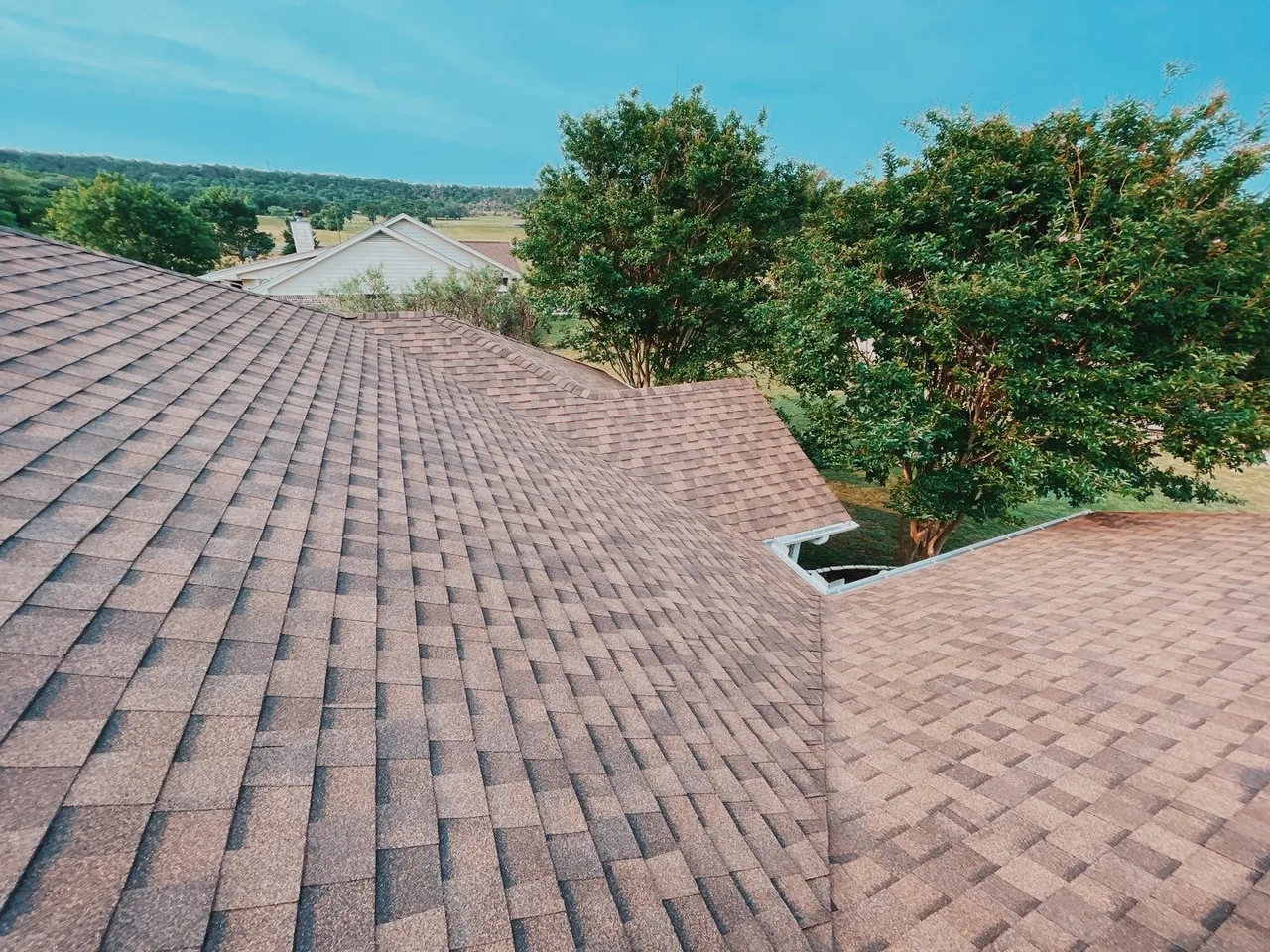
The best time to replace a roof in Central Texas is fall, October and November, when afternoons are warm enough for shingles to seal and the 100-degree days are over. Late winter and early spring, before hail season builds, is the second-best window. A roof can go on in any month here if the crew works with the weather, so the season matters less than whether your roof can safely wait for it.
Why is fall the easiest season for a roof replacement?
Fall gives a Central Texas roof replacement mild days and enough sun to seal the shingles. The NOAA Regional Climate Centers’ ACIS record for Austin Camp Mabry puts the normal October high at 82.5 degrees with a low of 60.8, and the normal November high at 71.5 degrees with a low of 50.5. That is comfortable working weather on a roof and warm enough for the sealant strip to do its job.
The sealing is the part a homeowner never sees. The Asphalt Roofing Manufacturers Association explains that most asphalt shingles carry a thermally activated sealant that bonds each course to the one below once the roof gets enough heat from the sun. Fall in Central Texas supplies that heat without the extremes. Rain is lighter too: across 2016 through 2025, Camp Mabry averaged 6.1 days with measurable rain in October and 6.3 in November.
Can a roof be replaced in a Texas summer?
A roof can be replaced in a Texas summer, but the heat changes how the work has to be done. Camp Mabry recorded 438 days at 100 degrees or hotter from 2016 through 2025, and 434 of them fell between June and September. The normal August high there is 97.8 degrees.
ARMA’s hot-weather bulletin says the asphalt coating on shingles softens in that heat, so crews should wear soft-soled footwear to avoid scuffing the surface, and laminated shingles can tear or lose their adhesive bond under rough handling. ARMA’s advice is to install early in the day, before the temperature peaks, and to work around the sun: west- and south-facing slopes in the morning, east- and north-facing slopes later. A summer replacement done that way turns out fine. A summer replacement rushed through a 3 p.m. heat wave is where scuff marks come from.
Is winter too cold to put on a new roof here?
Winter in Central Texas is usually mild enough for a roof replacement, with care on the cold days. The normal January high at Camp Mabry is 62.5 degrees and the normal low is 41.8. ARMA’s cold-weather bulletin says shingles become less flexible as temperatures drop and may crack if bundles are bent, thrown or dropped, and it recommends storing them somewhere warm before they go up.
ARMA also notes that sealing takes longer when the roof gets little sun, and that in very cold weather shingles can be hand-sealed with an approved roofing cement for wind resistance. It defers to each shingle manufacturer for the minimum installation temperature, which is why the instructions for the specific shingle going on your house are the ones that count. Frost is the other winter hazard: ARMA warns that a nearly invisible layer of frost or ice can make a roof extremely hazardous, and advises waiting until the surface is clear. We covered what a freeze does to an existing roof in our winter roof prep article.
Why does spring fill up so fast?
Spring is hail season in Williamson County, and that is when roofing calendars fill. NOAA’s Storm Events Database records 203 hail events in the county from 2016 through 2025, and 163 of them, or 80 percent, fell between March and June. April led with 70 events and May followed with 62. May is also the wettest month of the year at Camp Mabry, with a normal 5.04 inches of rain and an average of 10.0 rain days from 2016 through 2025.
So late February and March is a good window for a planned replacement, before the storms. A replacement planned for May runs into rain delays and a crowded schedule after every hailstorm. September deserves a note as well: it was the county’s third-busiest hail month in that record, with 31 events.
How do permits affect when the work can start?
Inside Georgetown city limits, a re-roof needs a city permit, and the City of Georgetown estimates 10 to 15 business days to process a residential one. The city says hail storms can change that, which is the same spring backlog showing up at the permit office. Once issued, a Georgetown roofing permit is valid for 180 days. Residential property outside the city limits does not need one from Georgetown. Other cities around Liberty Hill set their own rules, so check with yours or ask your roofer who pulls the permit.
When should you not wait for a better season?
A roof that is leaking, missing shingles or holding a tarp should not wait months for ideal weather. The fix in that case is a roof repair or a temporary cover now, and the replacement scheduled for the next good window. A roof that is simply getting old, with no active problem, is the one that can be planned around fall or early spring.
If you are weighing a roof replacement in Liberty Hill, Georgetown, Leander or Cedar Park, we can look at the roof, tell you plainly whether it needs to happen this season or can wait for a better one, and plan the timing with you.