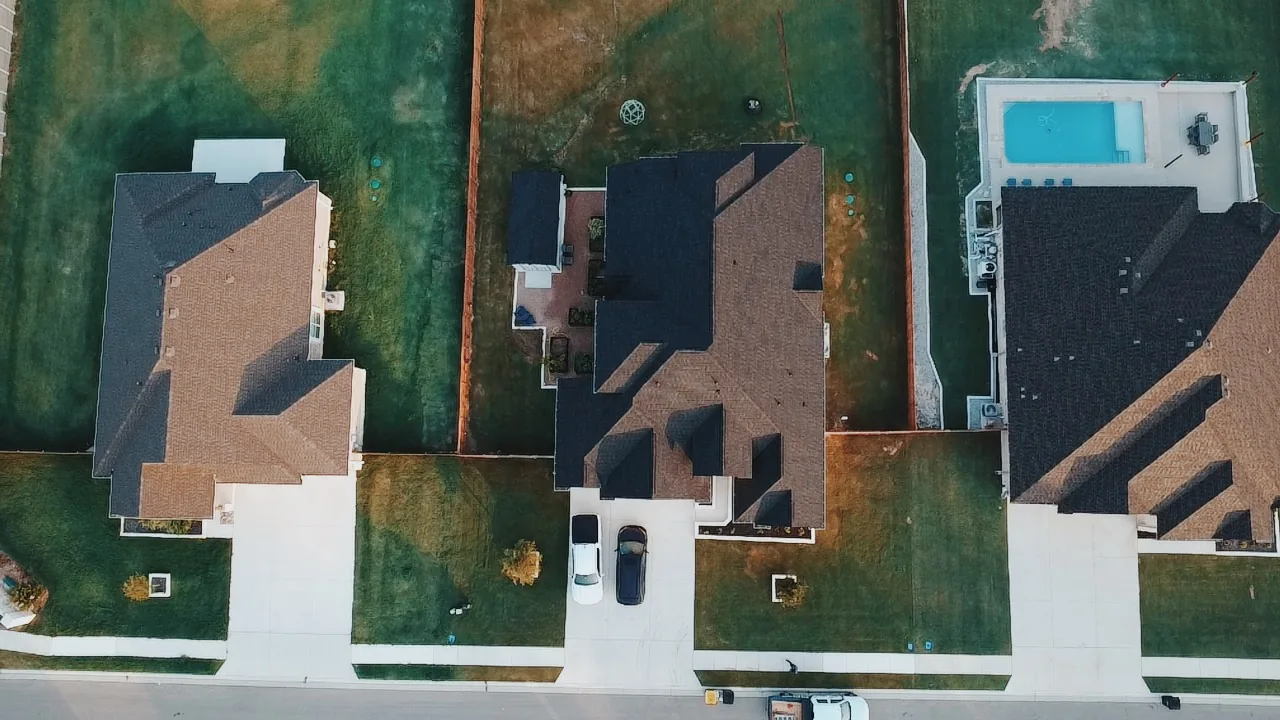
Wind damage on a shingle roof looks like creases, folds and torn or missing tabs, usually along the edges, the ridge and the eaves first. A shingle that has been lifted by wind keeps a mark of it: building enclosure engineers writing for IIBEC found that a sealed shingle bent back by wind leaves lasting creases, folds or tears that can be seen when the roof is examined carefully. A shingle that is loose but carries none of those marks is a different problem, and telling the two apart is most of what a wind inspection is.
We are based in Liberty Hill and we inspect and repair storm-damaged roofs across Georgetown, Leander, Cedar Park, Round Rock and Austin. This is what wind actually does to a shingle, where it shows up first, what you can check from the ground, and what we look for when we go up.
How strong does wind have to be to damage shingles?
There is no single wind speed at which shingles fail, because the condition of the roof matters as much as the storm. The National Weather Service does give a useful scale. It calls a thunderstorm severe when its gusts reach 58 mph or greater, and it sorts storm gusts into four bands:
| Gust speed | What the National Weather Service calls it |
|---|---|
| 39 mph to 57 mph | Strong wind gusts |
| 58 mph to 74 mph | Damaging gusts, causing minor damage |
| 75 mph to 91 mph | Very damaging gusts, causing moderate damage |
| 92 mph or more | Violent gusts, causing major damage |
Shingles are rated well above most of those numbers. ASTM International and the International Code Council have adopted wind ratings for asphalt shingles that run up to 150 mph. Shingles still come off in storms far weaker than that, and the reason is the sealant strip, not the shingle.
Why do shingles blow off in a storm?
Shingles blow off mostly because they have come unstuck from the course below. The Insurance Institute for Business & Home Safety, which has been weathering shingles on test roofs since its Roof Material Aging Farm program launched in 2013, found that unsealing remains the single greatest driver of wind vulnerability. A shingle that has lost its sealant bond is much more likely to fail in strong wind.
Once one edge lets go, the wind does the rest. IIBEC’s engineers describe a lifted shingle exposing more of its surface to the wind, which raises the uplift, which lifts it further until the shingle flips back and creases or tears. The break typically happens at the top of the exposed section, just below the bottom edge of the shingle above it.
Does the age of the roof matter?
The age of a shingle roof matters a great deal for wind. IBHS tested shingles that had weathered naturally for 10 years in South Carolina, Wisconsin and Ohio, and found that many products gained wind resistance in their first few years and most began to lose it between years five and 10. A 2014 study quoted by IIBEC found shingles appear to stay sealed for the first 4-5 years of service, after which unsealing trends upward.
Ratings do not settle it either. Every product in the IBHS study carried the industry’s highest wind classification, and their performance after aging was still dramatically different. FEMA’s own advice is to use wind ratings to choose among shingles but not to rely on them for performance. IBHS also found that climate affects how well the sealant activates and holds, which is worth knowing in a place with Central Texas summers.
What does wind damage look like on a shingle?
Wind damage on a shingle shows up as one or more of four things:
- Creases. A horizontal line across the shingle, near the top of the exposed part, where it bent back and folded. On a newer shingle the crease can be faint enough that it takes a hand under the tab to find.
- Folds. A tab that flipped and stayed partly turned up.
- Tears. Part of a tab ripped away along the crease line.
- Missing shingles or pieces. Bare patches, exposed underlayment, or shingle pieces in the yard.
The edges of the roof take the worst of it. IIBEC notes that tabs break off particularly at the eaves, hips and ridges, where wind forces on a roof are highest. Ridge caps and the first course at the eave are where we look first after a wind storm.
What gets mistaken for wind damage?
A shingle that is loose but has no crease, fold or tear is not, on its own, evidence of wind damage. IIBEC’s engineers list the other things that break a sealant bond: manufacturing inconsistencies, poor installation, age, installation in cold weather, dirt in the adhesive, and the daily expansion and contraction of the roof. University of Florida researchers, cited in the same article, traced unsealed shingles to under-driven nails in the sealant strip, debris on the strip, and release tape left stuck to it.
That distinction matters for what gets fixed and how. A creased shingle has been bent past what it can recover from and needs replacing. A run of unsealed shingles with no creases is an installation or age problem, and the fix is different. We write down which one we found and where, with photographs, so you are not guessing.
What can you check from the ground?
Most of what matters after a wind storm can be seen without leaving the ground. The Texas Department of Insurance tells homeowners to check the roof for missing or damaged shingles after a storm and to remove tree limbs hanging over or near the roof. From the yard, and with binoculars if you have them, look for:
- Shingles or shingle pieces in the yard, the beds or the gutters.
- Bare or darker patches on the roof where a shingle used to be.
- Ridge caps that are missing or sitting crooked.
- Tabs that are turned up at the edges of the roof.
- Broken limbs on or over the roof. The National Weather Service notes that severe thunderstorm winds can break off large branches and knock over trees.
- New stains on ceilings, especially on the top floor.
Stay off the roof and off the ladder. CDC’s National Institute for Occupational Safety and Health reports that more than 500,000 people are treated and about 300 people die each year in the US from ladder-related injuries. Creases often need a hand under the tab to confirm, which is a job for someone who is up there with the right gear.
What we look for on a wind inspection
On a wind inspection we walk the whole roof and start where the wind hits hardest: the ridge, the hips, the eaves and the rakes. We lift tabs by hand to find creases, note which shingles are torn or missing, and separate wind damage from unsealing that has another cause. Every finding is photographed and written down by location, so you have a record of the roof as it stood after the storm.
When the damage is a section of creased or missing shingles, the answer is usually a roof repair: new shingles nailed and sealed into the existing courses. FEMA’s guidance for high-wind areas calls for six nails per shingle and roofing nails rather than staples, and for checking after enough sunshine that the new tabs have actually sealed. When the roof is older and unsealing is widespread, patching one slope does not fix the rest of it, and we will tell you if a replacement is the honest answer.
Where our part stops and your insurer’s begins
Our part is the roof: inspecting it, documenting what wind did and did not do, and doing the work. Whether any of it is covered, and for how much, is between you and your insurance company. We are a licensed contractor, not a public adjuster, and we cannot negotiate a claim for you. The Texas Department of Insurance advises homeowners to be there when the adjuster visits and point out all the damage, and our photographs and notes are yours to use. Texas law also makes it illegal for a roofer to offer to waive your deductible, so be wary of anyone who does.
When to have a roof looked at after wind
Have a roof looked at after any storm that left shingles in the yard, limbs on the roof, or a new stain on a ceiling. The Texas Department of Insurance also suggests a roof inspection every few years whether or not a storm hit, which on an older roof is how unsealing gets found before the wind finds it.
If you think wind got to your roof, contact us or call (512) 619-2976. We will come out, go up so you do not have to, and show you what we found.