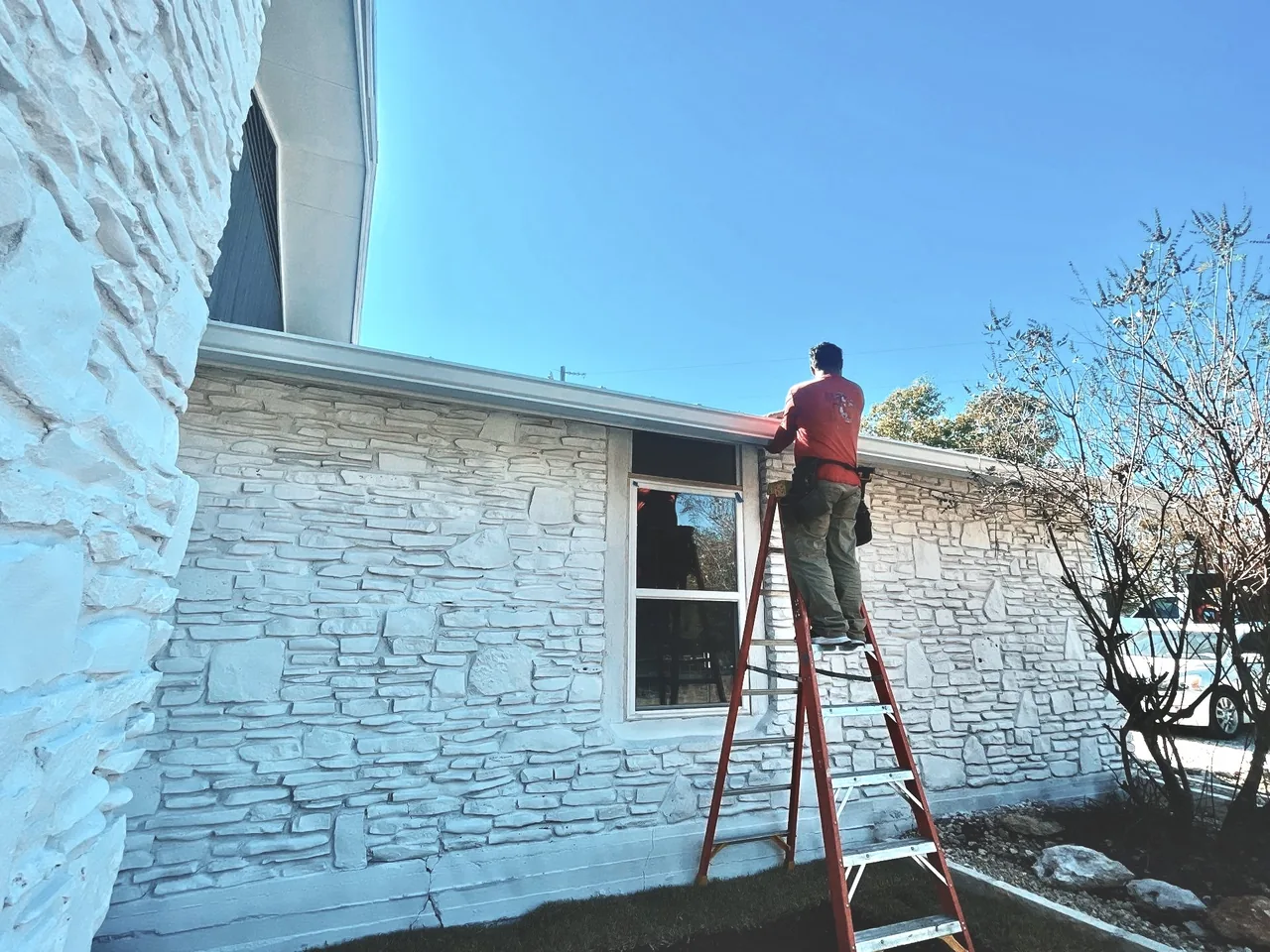
On a Liberty Hill house, soffit and fascia damage is almost always a symptom of something else: water getting to the roof edge, insects nesting in the trim, or an animal working its way into the attic. Fascia is the board the gutters hang on, and soffit is the panel under the overhang. When either one rots, sags or grows a hole, replacing the board fixes what you can see, and finding the cause is what keeps it fixed.
What causes fascia boards to rot?
Fascia rots because it stays wet, not because Central Texas is humid. The USDA Forest Products Laboratory’s Wood Handbook says serious decay happens only when wood is above its fiber saturation point, about 30% moisture, and that previously dried wood only gets there from rain, condensation or contact with wet ground. Humid air on its own does not wet wood enough to support significant decay.
At a roof edge, that liquid water usually comes from the gutter. A gutter that overflows or pulls away from the board pours water down the back of the fascia every time it rains. The same handbook names roof edges as one of the critical places in a building and calls for gutters and downspouts kept free of debris. If the rot runs along the line where your gutter hangs, the gutter is the first suspect, and that is worth a look on our gutter page.
Can rotted fascia be patched, or does the board have to go?
A soft fascia board almost always gets replaced, and the work only lasts if the water source is fixed with it. The Forest Products Laboratory states that wood kept air dry, usually below 20% moisture, will not decay, and that decay already present stops progressing once the wood stays dry. The handbook also says decay problems in buildings are almost always a sign of faulty design or construction, careless handling or poor maintenance.
That is why we probe past the soft spot before we quote anything. Rot that stops at one gutter seam is a short board and a gutter adjustment. Rot that has reached the rafter tails or decking behind it is a bigger repair, better found while the board is off.
What do round holes in the fascia or soffit mean?
Clean, round holes about half an inch across in the fascia or the underside of the eaves usually mean carpenter bees. The Wood Handbook describes female carpenter bees boring 1/2 inch tunnels into soft wood, nesting in bare wood and in wood with only a stain or thin paint film, and favoring exterior wood out of direct sun. The handbook adds that carpenter bees reuse the same nest sites for years and nesting recurs each spring.
Rows of small, rougher holes that appear after the bees are a different visitor. The Illinois Department of Natural Resources’ wildlife program notes that woodpeckers drill foraging holes into fascia looking for carpenter bees and other insects. The Forest Products Laboratory says a good paint film or pressure-treated wood protects exterior wood from nesting, which is why bare or peeling trim gets primed and painted as part of the repair.
What does a chewed hole in the soffit mean?
A ragged, chewed opening at the eave usually means a squirrel or a raccoon is using it as a door to the attic. Illinois DNR says smaller chewed holes usually point to a squirrel and larger ones to a raccoon. Texas A&M AgriLife Extension’s guidance on attic rodents says a 1/2 inch gap is all a squirrel needs, and that squirrels sometimes open large holes in soffits and fascia and chew on wiring inside the house.
The order of work matters. AgriLife says squirrel control generally means a one-way door or repeater trap at the entry point, and that no toxic baits are labeled for squirrels. If a wildlife professional has not cleared the attic first, a new soffit panel can seal an animal inside. We patch the opening once the attic is empty, not before.
Why does a vented soffit have screen behind it?
Vented soffit is part of the attic’s ventilation, and the building code sets its opening size. The 2012 International Residential Code, which Texas law adopts as its residential code, requires vent openings between 1/16 inch and 1/4 inch in their smallest dimension under Section R806.1, with anything larger covered by corrosion-resistant wire cloth or hardware cloth. A torn screen or missing vent panel is an open door for bees and squirrels alike.
The same code sets the attic’s net free vent area at 1/150 of the attic floor, or 1/300 when 40 to 50 percent of it sits in upper vents no more than 3 feet below the ridge and the rest comes from eave or cornice vents. Section R806.3 requires a 1-inch space between insulation and roof sheathing at the vent so insulation does not block the airflow. Solid panels over a vented eave, or insulation packed into it, take away the intake half of that system.
Should I worry about soffit panels that are loose or sagging?
A soffit panel that hangs loose is worth fixing before the next storm, because a loose panel is an opening into the attic. The Federal Alliance for Safe Homes reports that soffit failure in storms has caused widespread ceiling and interior damage, and recommends having a licensed roofing or general contractor check that roof accessories are anchored and secure. A panel that sags along its length often means the fascia or nailing behind it has failed, which usually traces back to water.
How to keep soffit and fascia from coming back as a problem
Most soffit and fascia trouble is prevented by the same few habits. The Texas Department of Insurance’s home checklist puts trimming trees that hang over the house and cleaning the gutters at the top of the outdoor list, and an overhanging limb is also the squirrel’s bridge to the eave. The National Roofing Contractors Association recommends a roof inspection twice yearly, in spring and fall, and after any severe storm, and the roof edge is part of that look. Keep the trim painted.
Soffit, fascia and eave repair is part of our roof repair work across Liberty Hill, Georgetown, Leander and Cedar Park. If you have a soft board, a hole or a sagging panel, we will find what caused it and tell you plainly how big the repair is. Book a look here.