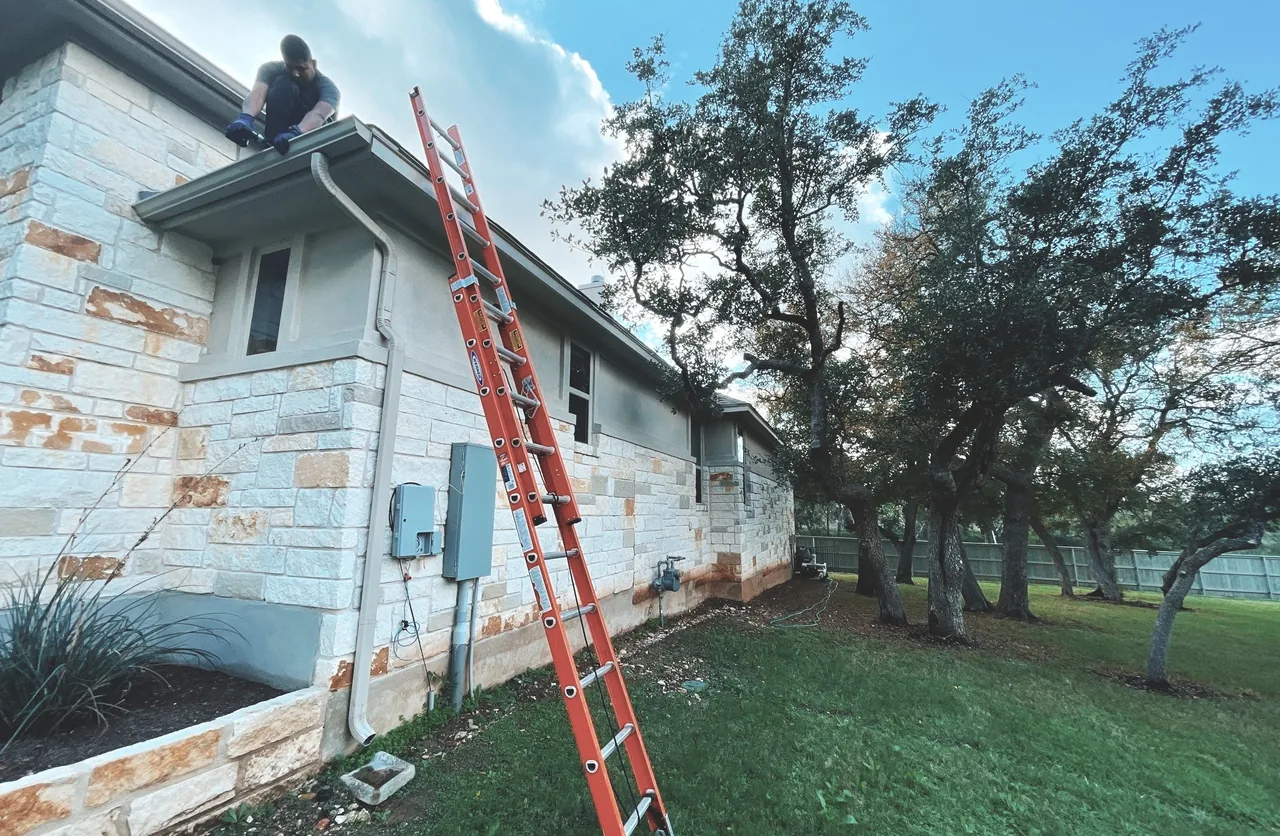
Gutters look like a roof accessory until you do the arithmetic on what they are carrying. The Texas Water Development Board puts it plainly: a homeowner can collect roughly 1,000 gallons for every inch of rainfall that falls on a 2,000 square-foot roof. That is half a gallon per square foot, per inch. On a Liberty Hill house in a decent Central Texas storm, that is several tons of water leaving the roof in an hour, and all of it lands somewhere.
Why where it lands matters more here
Central Texas sits on clay, and clay changes size with moisture. The Colorado Geological Survey's description of the mechanism is the clearest we have found: water molecules work their way between microscopic clay plates and push them apart, and the process reverses as the soil dries. Natural clay soils commonly swell to more than 1.5 times their original volume, and engineers treat swelling of 3 percent or more as potentially damaging.
That is not a small-stakes problem. The same source notes that shrinking and swelling soils inflict a few billion dollars of damage a year nationally, more than floods, hurricanes, tornadoes and earthquakes combined. A roof that dumps its water in one spot beside the slab is doing something specific: keeping one corner of the soil wet while the rest of the house sits on soil that is drying out.
How far from the house the water has to go
The Department of Energy's Building America Solution Center gives numbers rather than opinions. Downspouts should carry water to a sloping final grade at least 5 feet from the foundation, or to an underground catchment at least 10 feet away that is not tied into the foundation drain. Lateral pipe should fall at least 5/8 inch per foot, which is a 5 percent slope.
Most of the drainage problems we see on inspections are not broken gutters. They are gutters working correctly into a splash block that puts 1,000 gallons two feet from the slab.
Whether your gutters are sized for your roof
The same guide gives a sizing rule worth knowing before anyone quotes you: allow 1 square inch of downspout cross-section for every 100 square feet of roof area, with downspouts placed every 20 to 50 feet along the run, and the gutter itself sloped at least 1/16 inch per foot so it drains rather than holds. Gutters come in 4, 5 and 6 inch sizes, and a 5 inch gutter on a large steep roof will overflow in a hard rain no matter how clean it is.
Overflow is the tell. If water sheets over the front edge during a storm, the problem is capacity or slope, not debris, and cleaning it will not fix it.
What you can check without a ladder
All of this is visible from the ground, which is where we would rather you stayed.
- Splash staining on the wall under a gutter joint or an end cap, which means water is escaping there routinely.
- A trench or bare channel in the bed below a downspout, which is the soil telling you where the water goes.
- Standing water within a few feet of the slab after a storm. The Building America guidance is explicit that saturated soil next to a foundation can wick through and bring mould and rot with it.
- Downspouts ending in a splash block rather than an extension. This is the most common and the cheapest to fix.
- Sagging runs that hold water between rains, which is a slope problem.
Doing it before winter
Autumn is the right time in Liberty Hill and Georgetown for two reasons. Leaves are about to fill whatever is up there, and the dry-then-wet cycle that moves clay is hardest on a house when drainage is already uneven. Fixing slope and extensions now costs a fraction of what the same water costs after a season of concentrating in one place.
If any of the signs above are on your house, our gutter service covers the inspection, the slope and the extensions, and we will tell you if the answer is that nothing needs doing. Where gutter trouble turns out to be a roof edge or fascia problem instead, that is roof repair and we will say so rather than sell you gutters.