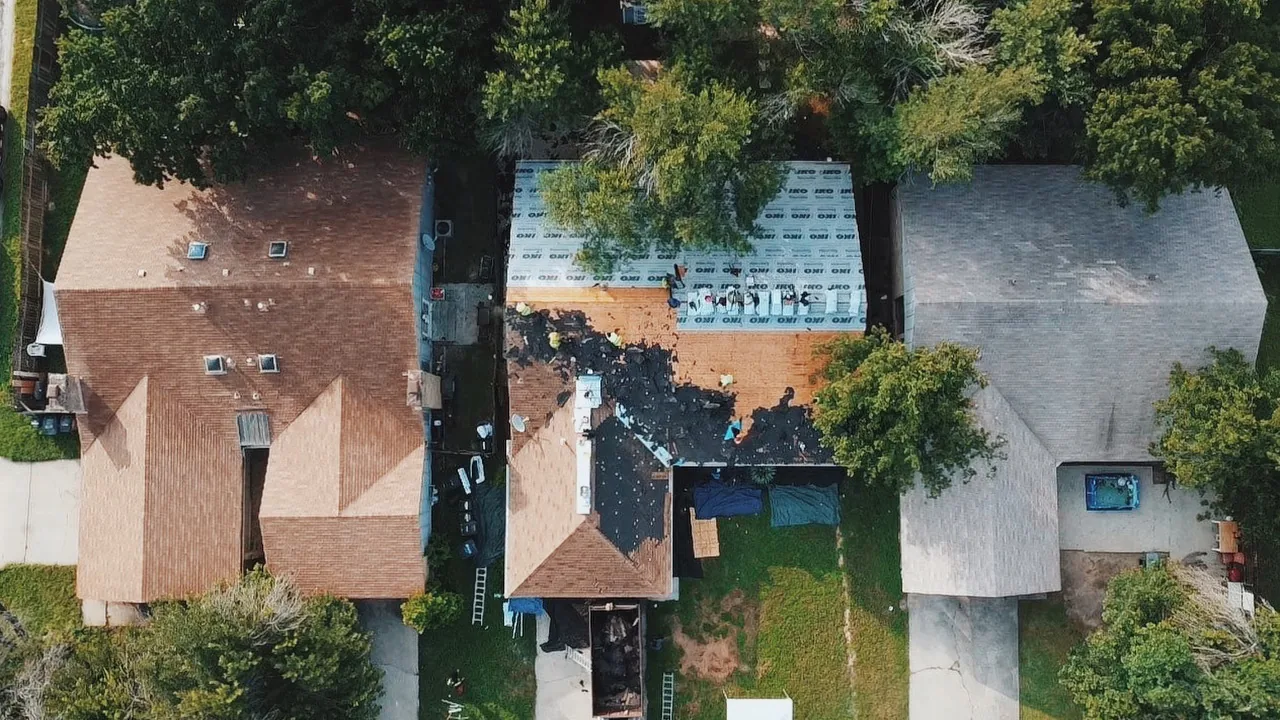
Most Central Texas roofs that come out of a storm get repaired rather than replaced, and the choice between a roof repair and a full replacement is less of a judgement call than it sounds. Three checkable things settle it before anyone’s opinion enters the room: how many layers of roofing are already on the house, what condition the wood deck underneath is in, and whether the damage sits in one place or turns up on every slope we walk. Roof age is the last thing we look at, not the first.
What makes a repair a repair
A repair is the right answer when the damage is local and the roof around it is sound. A handful of shingles off a rake edge after a wind event, a bruised section on the one slope that faced the storm, a flashing detail that has lifted at a wall, all of that is repair work so long as the deck is dry and the rest of the roof is still doing its job. What we are testing on the roof is whether the material around the damage has service left in it. That is a judgement made by hand, on the slope, and it is the reason we will not quote a roof from a photograph.
How many layers are already up there
This part is not a judgement at all, and it is the one homeowners are most often surprised by. Texas adopted the 2012 International Residential Code as its municipal residential building code under Texas Local Government Code Section 214.212, and that code governs repair and remodelling, not only new construction. Its Section R907.3 states that new roof coverings shall not be installed without first removing all existing layers where the existing roof has two or more applications of any type of roof covering, and says the same where the existing roofing is water-soaked or has deteriorated to the point that it is no longer an adequate base.
The Asphalt Roofing Manufacturers Association makes the manufacturer half of that point: most building codes do not allow more than two roof coverings on a building, and most manufacturers do not recommend installing new shingles over existing laminated shingles. So a house already carrying two layers has had the decision made for it. If it needs more than a spot repair, everything comes off.
What the deck underneath decides
Nobody sees the deck without taking the roof off it, which is the honest argument for a replacement on a house where the wood is suspect. ARMA lists the conditions that force a tear-off: rotted or warped wood, gaps wider than a quarter inch, and structural sagging along a ridge or truss line. It also names the upside plainly, that replacement is the opportunity to inspect the roof deck, repair any damage, and improve how the deck is attached to the structure underneath.
The manufacturer we install is just as specific about that surface. IKO’s application instructions for Dynasty shingles require a deck that is smooth, firm, clean, dry and securely nailed, at least 3/8 inch plywood or 7/16 inch non-veneer panel, and IKO states it assumes no responsibility for leaks or defects resulting from improper preparation of the surface being roofed over. Shingles laid over soft decking are a repair that fails twice: once on the roof and once on the warranty.
One slope, or the whole roof
Hail does not land evenly on a house, and that unevenness is diagnostic. The Insurance Institute for Business & Home Safety tests shingles with laboratory hailstones of 1.5 and 2.0 inches and evaluates three separate kinds of damage: dents, tears, and granule loss. Those show up differently on a roof. Damage confined to the slopes that faced the storm is the shape of a repair. The same marks on every elevation, including the ones the storm never faced, are usually not storm damage at all but a roof at the end of its service life, and patching one slope of it buys a season.
Why hail in April becomes a wind problem in November
NOAA’s Storm Events Database records 203 hail events in Williamson County across the ten years 2016 through 2025. 163 of them, 80 percent, fell in the four months from March to June. September is the third-busiest month in that record with 31 events, behind April at 70 and May at 62. Liberty Hill is named in 21 of those reports, the largest of them at 1.50 inches.
That timing matters for the repair decision, because a bruise that is not leaking in May can still become a problem in the autumn. ARMA describes the sealant on an asphalt shingle as thermally activated: heat and UV from the sun soften it so that it bonds to the course below, and that bond is what gives a finished roof its wind resistance. Shingles are vulnerable to wind until it forms. IBHS puts sealant strength as a critical factor in resisting wind damage, particularly after hail impact. It is also why IKO’s instructions call for hand-sealing with roofing cement when cool weather, high wind or blowing dust might limit the sealing strip. A repair made in January is not the same repair made in June, and we will tell you which one you are getting.
What your insurer decides, and what we are not allowed to do
Everything above is a decision we make with you on the roof. The money is a separate question with a separate decision-maker. The Texas Department of Insurance sets out the two shapes a policy takes: replacement cost coverage pays the full cost to repair the roof at current prices, and actual cash value pays less if the roof is older or showing wear. TDI also states that as roofs age some companies switch to actual cash value, and that an insurer will not pay for a new roof simply because it is old or worn out. Read your own declarations page for which one you have.
Our part is to inspect, photograph and document what is actually on your roof, and to be there when your adjuster is. What we are not permitted to do is act for you against your insurer. TDI is explicit that Insurance Code Section 4102.163 bars a contractor who provides contracting services from acting as a public adjuster, and that Business and Commerce Code Section 27.02 bars waiving or rebating your deductible. A roofer who offers to do either is telling you something useful about themselves. Our inspection and documentation process is the whole of what our side looks like.
When to have it looked at
The National Roofing Contractors Association has given the same answer for decades: inspect twice yearly, in spring and autumn, and inspect after any severe storm. In this county that puts one look before hail season and one after it.
If you are somewhere between the two, a roof repair is the outcome we reach most often, and we would rather sell you that than a roof you do not need. Where the layers, the deck or the spread of the damage rule it out, we will show you which of the three it was before we talk about replacement.